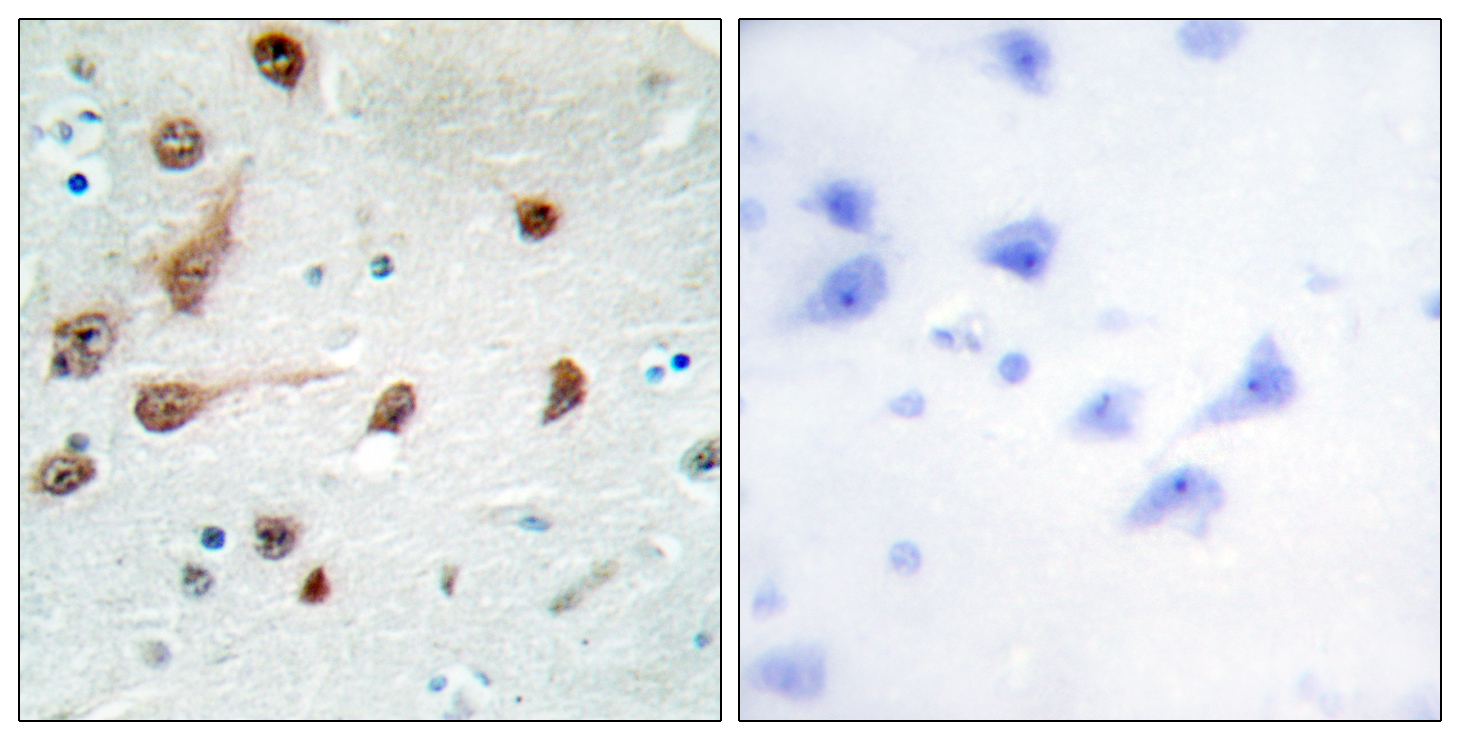
产品名称
ADAR1 Rabbit Polyclonal Antibody
别名
ADAR; ADAR1; DSRAD; G1P1; IFI4; Double-stranded RNA-specific adenosine deaminase; DRADA; 136 kDa double-stranded RNA-binding protein; p136; Interferon-inducible protein 4; IFI-4; K88DSRBP
蛋白名称
Double-stranded RNA-specific adenosine deaminase
存储缓冲液
Liquid in PBS containing 50% glycerol, 0.5% BSA and 0.02% New type preservative N.
Human Gene Link
http://www.ncbi.nlm.nih.gov/sites/entrez?db=gene&term=103
Human Swissprot No.
P55265
Human Swissprot Link
http://www.uniprot.org/uniprotkb/P55265/entry
Mouse Gene Link
http://www.ncbi.nlm.nih.gov/sites/entrez?db=gene&term=56417
Mouse Swissprot No.
Q99MU3
Mouse Swissprot Link
http://www.uniprot.org/uniprot/Q99MU3
Rat Gene Link
http://www.ncbi.nlm.nih.gov/sites/entrez?db=gene&term=81635
Rat Swissprot Link
http://www.uniprot.org/uniprot/P55266
免疫原
The antiserum was produced against synthesized peptide derived from human ADAR1. AA range:1172-1221
特异性
ADAR1 Polyclonal Antibody detects endogenous levels of ADAR1 protein.
宿主
Polyclonal, Rabbit,IgG
背景介绍
adenosine deaminase, RNA specific(ADAR) Homo sapiens This gene encodes the enzyme responsible for RNA editing by site-specific deamination of adenosines. This enzyme destabilizes double-stranded RNA through conversion of adenosine to inosine. Mutations in this gene have been associated with dyschromatosis symmetrica hereditaria. Alternative splicing results in multiple transcript variants. [provided by RefSeq, Jul 2010],
组织表达
Ubiquitously expressed, highest levels were found in brain and lung (PubMed:7972084). Isoform 5 is expressed at higher levels in astrocytomas as compared to normal brain tissue and expression increases strikingly with the severity of the tumor, being higher in the most aggressive tumors.
细胞定位
[Isoform 1]: Cytoplasm . Nucleus . Shuttles between the cytoplasm and nucleus (PubMed:7565688, PubMed:24753571). Nuclear import is mediated by TNPO1 (PubMed:24753571). .; [Isoform 5]: Cytoplasm . Nucleus . Nucleus, nucleolus . Predominantly nuclear but can shuttle between nucleus and cytoplasm. TNPO1 can mediate its nuclear import whereas XPO5 can mediate its nuclear export. .
信号通路
Cytosolic DNA-sensing pathway;
功能
caution:The N-terminus of isoform 4 has been derived from EST and genomic sequences.,disease:Defects in ADAR are a cause of dyschromatosis symmetrical hereditaria (DSH) [MIM:127400]; also known as reticulate acropigmentation of Dohi. DSH is a pigmentary genodermatosis of autosomal dominant inheritance characterized by a mixture of hyperpigmented and hypopigmented macules distributed on the dorsal parts of the hands and feet.,function:Converts multiple adenosines to inosines and creates I/U mismatched base pairs in double-helical RNA substrates without apparent sequence specificity. Has been found to modify more frequently adenosines in AU-rich regions, probably due to the relative ease of melting A/U base pairs as compared to G/C pairs. Functions to modify viral RNA genomes and may be responsible for hypermutation of certain negative-stranded viruses. Edits the messenger RNAs for glutamate receptor (GLUR) subunits by site-selective adenosine deamination. Produces low-level editing at the GLUR-B Q/R site, but edits efficiently at the R/G site and HOTSPOT1. Binds to short interfering RNAs (siRNA) without editing them and suppresses siRNA-mediated RNA interference. Binds to ILF3/NF90 and up-regulates ILF3-mediated gene expression.,induction:Isoform 1 is induced by interferon alpha. Isoform 5 is constitutively expressed.,PTM:Sumoylation reduces RNA-editing activity.,similarity:Contains 1 A to I editase domain.,similarity:Contains 2 DRADA repeats.,similarity:Contains 3 DRBM (double-stranded RNA-binding) domains.,subcellular location:Isoform 1 is found predominantly in cytoplasm but appears to shuttle between the cytoplasm and nucleus. Isoform 5 is found exclusively in the nucleolus.,subunit:Homodimer. Isoform 1 interacts with ILF2/NF45 and ILF3/NF90.,tissue specificity:Ubiquitously expressed, highest levels were found in brain and lung.,
纯化
The antibody was affinity-purified from rabbit antiserum by affinity-chromatography using epitope-specific immunogen.